

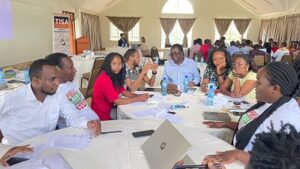
 As Kenya gradually moves toward the 2027 General Elections, stakeholders in Makueni County convened for a critical dialogue aimed at shifting focus from divisive politics to issue-based governance and accountability.
The forum, held under the Tupigane Na Ufisadi (TUNU) Project, implemented by The Institute for Social Accountability (TISA) in partnership with Konrad Adenauer Stiftung (KAS) and Transparency International Kenya (TI-Kenya), and supported by the European Union (EU) and BMZ, brought together civil society organizations, media, and county government representatives.
The meeting was officially opened by the County Executive Committee Member (ECM) for Devolution, Public Participation, County Administration and Special Programs, Nicholas Nzioka, who emphasized the importance of sustaining accountability gains and strengthening citizen engagement, especially during politically charged periods.
Addressing the Challenge of Electioneering and Accountability
The forum comes at a time when Kenya’s political environment is increasingly dominated by identity politics, alignment narratives, and personality-driven debates. Participants acknowledged that such trends often divert attention from critical development issues, risking a rollback of progress made in transparency, oversight, and service delivery.
Through this engagement, stakeholders were challenged to move beyond political rhetoric and instead focus on real issues affecting citizens, reinforcing the idea that “issues—not politics—are the antidote to impunity.” 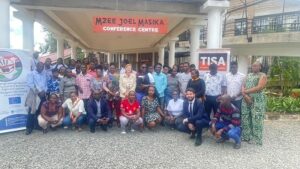
Using Data to Drive Accountability
A key highlight of the session was the emphasis on using credible data from oversight institutions such as the Office of the Controller of Budget (OCoB) and the Office of the Auditor General (OAG) to guide discussions.
Participants were equipped with practical skills to:
- Translate political statements into service delivery questions
- Use budget and audit data to fact-check narratives
- Promote evidence-based advocacy and reporting
This approach aims to empower:
- CSOs to develop stronger petitions and conduct community audits
- Media to ask informed, data-driven questions
- County officials to engage transparently using verified information
Building a “Safe Dialogue Zone”
The forum created a collaborative platform where civil society, media, and county officials engaged constructively to identify priority development issues that should shape public discourse ahead of the 2027 elections.
This “safe dialogue zone” enabled stakeholders to:
- Share perspectives openly
- Build mutual trust
- Agree on key county priorities to guide future engagement
Advancing the TUNU Project Objectives
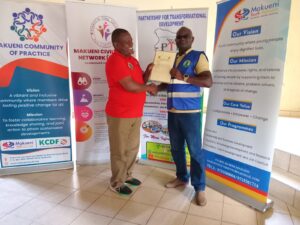
This activity directly contributes to the TUNU Project’s goal of strengthening civil society as independent actors of good governance. By leveraging digital tools, public education, and multi-stakeholder collaboration, the initiative continues to promote:
- Transparency and access to information
- Citizen empowerment
- Accountability in public resource management
Conclusion
The forum marks a significant step in ensuring that as Kenya approaches the 2027 elections, the conversation remains grounded in service delivery, accountability, and public interest.
Through the continued support of partners and the commitment of local stakeholders, the TUNU Project is helping to redefine governance conversations—placing citizens, facts, and development priorities at the center.